

Nativity Nostalgia Cannot Shape Public Education
Using the Nativity to Defend a Monocultural School System Misses the Point

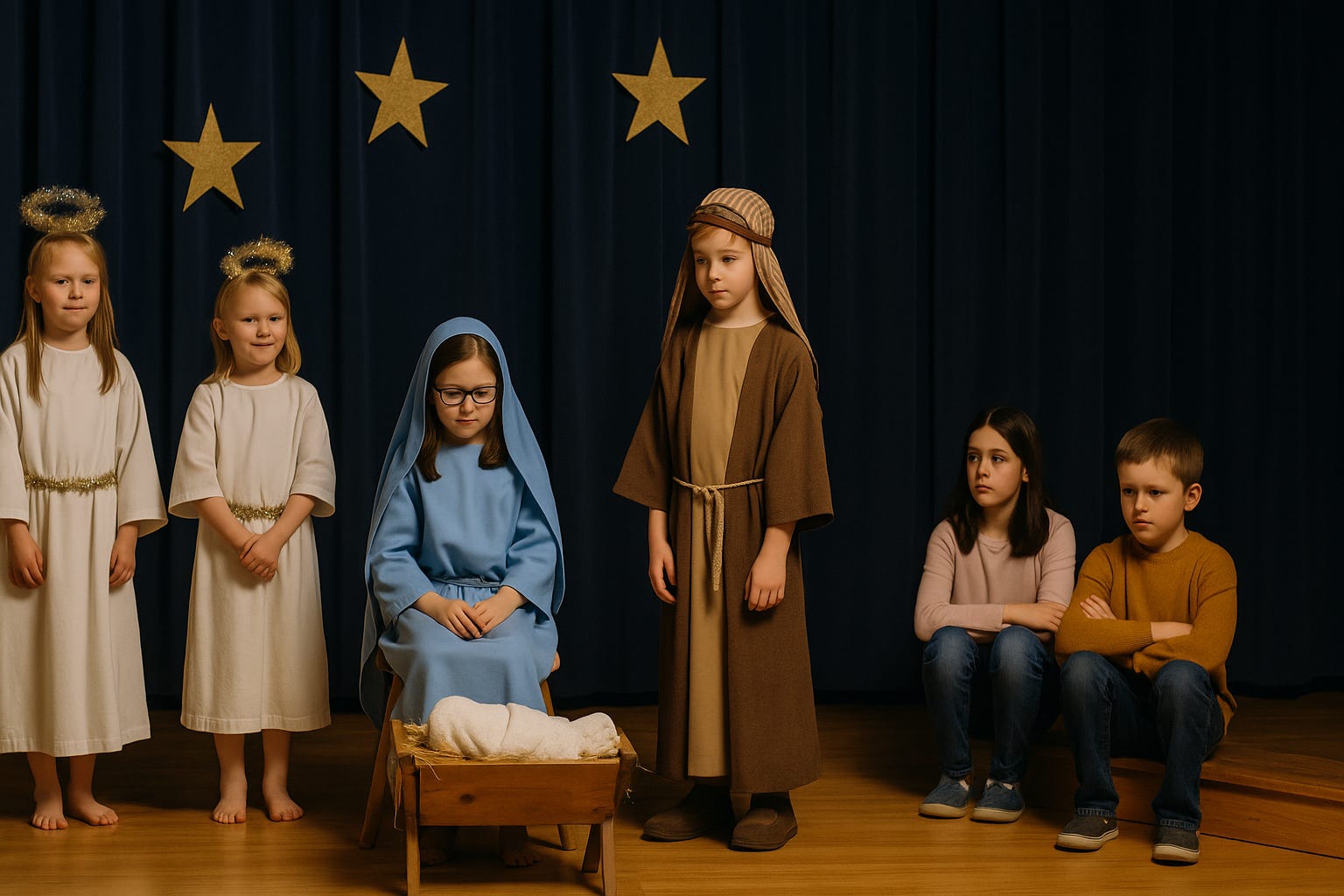
Breda O’Brien’s recent column in the Irish Times used the familiar imagery of tinsel halos and tea towel shepherds to make a broader argument about the place of religion in schools. She is far from the first to do so. Whenever the conversation about patronage reform appears, as it is with the Primary Schools Ethos Survey, we are invited to picture small children on a stage, forgetting their lines in an endearing Nativity play. The implication is that if we question faith schooling, we must be threatening this particular cherished childhood ritual. It is a clever move. The same often happens around sacrament season, with veiled threats that children will no longer be allowed have bouncy castles with their classmates.
The Nativity and sacraments are never raised as a matter of educational philosophy, you know, the thing that schools are supposed to be for. These events are raised because they are highly emotionally loaded. Evoke the Nativity and you evoke nostalgia, innocence, memory and cultural belonging. It’s likely if you were in a Nativity Play when you went to school in Ireland, you probably remember how proud your parents were of you and the fuzzy feeling that brings. If you made your Communion, you probably remember all the fuss over you and how everyone said how lovely you were and, possibly how much money you got. When people raise these things, they place their desired reader instantly on familiar ground. They soften any critical examination of a system where one religious tradition controls nearly every primary school and distract them to a cognitive dissonance. They don’t see the families that don’t have this story and if they do, they see them as outsiders, as aliens, as a threat.
The unspoken message is simple:
“If you challenge the structure, you are trying to take something magical away from children.”
You don’t need me to tell you this is not true. You probably already know it diverts attention from the real issue: the experiences of minoritised children and adults in a system that treats one religious narrative as the norm and all others as something to tolerate.
The most persistent defence I’ve heard from teachers, in particular, is that no child is excluded from the Nativity. Families are told they may opt out if they like. This sounds reasonable until you consider that this really means they have a choice not to be part of one of the biggest celebrations in the school calendar. That’s not a choice; it’s an ultimatum.
We’ve become so immune to the idea that opting out isn’t exclusion by another name, that we don’t think about it. Opting out is not a neutral act. It requires a child and his/her family to publicly mark themselves as different. It means missing celebrations, being supervised elsewhere, or sitting alone at the back of the hall while the celebration preparation is happening. It means every December becoming visibly “not like the others”. It’s the same in April and May with the sacraments.
No child should have to carry that burden.
Defenders will often cite anecdotal tales of diversity working beautifully in Catholic schools. The most infamous one for me was the story told at the IPPN conference in 2011 when a former politician spoke about her very inclusive all-girls Catholic school where three Muslim girls wearing hijabs were cast as the Three Wise Men in a Nativity play. I sat among the almost 1,000 principals as they gave a thunderous round of applause. I had never felt more lonely and isolated. It’s as close I could feel to how an opted out child feels at the back of the class.
Hopefully we are living in less ignorant times and we all know that those girls were not performing a story from their own culture. They were adapting themselves into a Christian narrative, probably because they were second generation migrants, who do what early migrants do. Ultimately, they were welcomed in so long as they took part in the majority’s ritual. I hope these days, we know that is not inclusion. It is assimilation at best, racist at worst.
Yes, racist. Minoritised children were celebrated not for bringing their own traditions, but for how neatly they could be folded into the traditions of the majority. When they participate in the dominant culture’s story, the audience applauds the school. But who applauds them when they express their own identity?
When I talk about this or people tell me those Muslim girls had a choice, we probably know the “choice” argument fails on another level. Would a Catholic parent happily send their child to a school where the annual performance was a Muslim drama, and their child had to be withdrawn because they did not believe in those stories? While, of course the answer would be a definitive “no,” you won’t be surprised to hear that most people defend it because they will defend it as “our culture.”
This line is usually delivered with confidence and occasionally with exasperation, as though multicultural Ireland arrived unexpectedly and started rewriting the script. The suggestion is that asking for change is somehow un-Irish. But this argument depends on a frozen idea of culture in a country that has changed dramatically.
Almost one quarter of primary pupils today come from ethnic minority backgrounds. More than one third of families are non-religious. Ireland in 2025 is not the Ireland of 1950. If cultural identity means anything, it must reflect the people actually in our schools, not a nostalgic idea of who we imagine them to be.
A public school system that serves every child cannot treat one faith as the cultural baseline.
Having said that, none of this means Christmas disappears. Multidenominational schools already mark Christmas. They teach about it, learn about it, and help those that celebrate it, celebrate it. What they do not do is compel children to perform a doctrinal drama or to believe the story of Christmas as fact. In these schools you will see lots of lights, lots of colour and the overwhelming warmth of the season of light. In other words, the joy remains, the pressure does not.
In most pluralist democracies, the pattern is straightforward. Religious plays take place in religious schools, and inclusive winter celebrations take place in public schools. Children enjoy concerts, art, music and seasonal traditions without being asked to enact a faith they may not share.
This is normal practice in Canada, New Zealand, the Netherlands, Scandinavia and the United States. Some might point to the UK, but don’t forget the UK is a Christian country by definition. Even so, the UK Supreme court judged that State schools were guilty of indoctrination and evangelism through the Nativity. In any case, Ireland is a secular republic.
We are the only country in Western Europe where the default public school is explicitly denominational. Our “public” system is really a patchwork of parish and religious patronage, and the Nativity is as dominant as it is because Catholic schooling is structurally baked into the state system. This is why the Nativity surfaces in every debate about change. It is not just a play.
It is the most visible symbol of a school system built on a single tradition.
When defenders of the status quo say “this is Ireland”, they are not really talking about culture. They are talking about a historical church-state arrangement that persists long after society has changed. In all other aspects of Ireland, people want the church-State relationship to be a part of history. We’ve read all the abuse reports. We’ve seen thousands protest against the National Maternity Hospital going into religious hands.
The problem is not that Ireland lacks Nativity plays. The problem is that Ireland lacks alternatives.
The real conversation is not about whether a Nativity play can still happen. It is about whether public education should reflect the children who attend it, rather than a historical church-state model that no longer matches Ireland’s demographic reality. It is about whether cultural celebration can thrive without compelling minority children to perform religious narratives. And it is about recognising that inclusion is not achieved by letting children join the majority’s ritual.
The Nativity is not under threat. Nostalgia is not under threat. Winter concerts will continue long after patronage reform is complete. The magic of December will not evaporate. It just might look a little more inclusive of everyone.
If a column about Nativity plays helps us have that conversation, then perhaps it has served a purpose after all.
I know I am biased but loved this article. Agree with everything and more.